
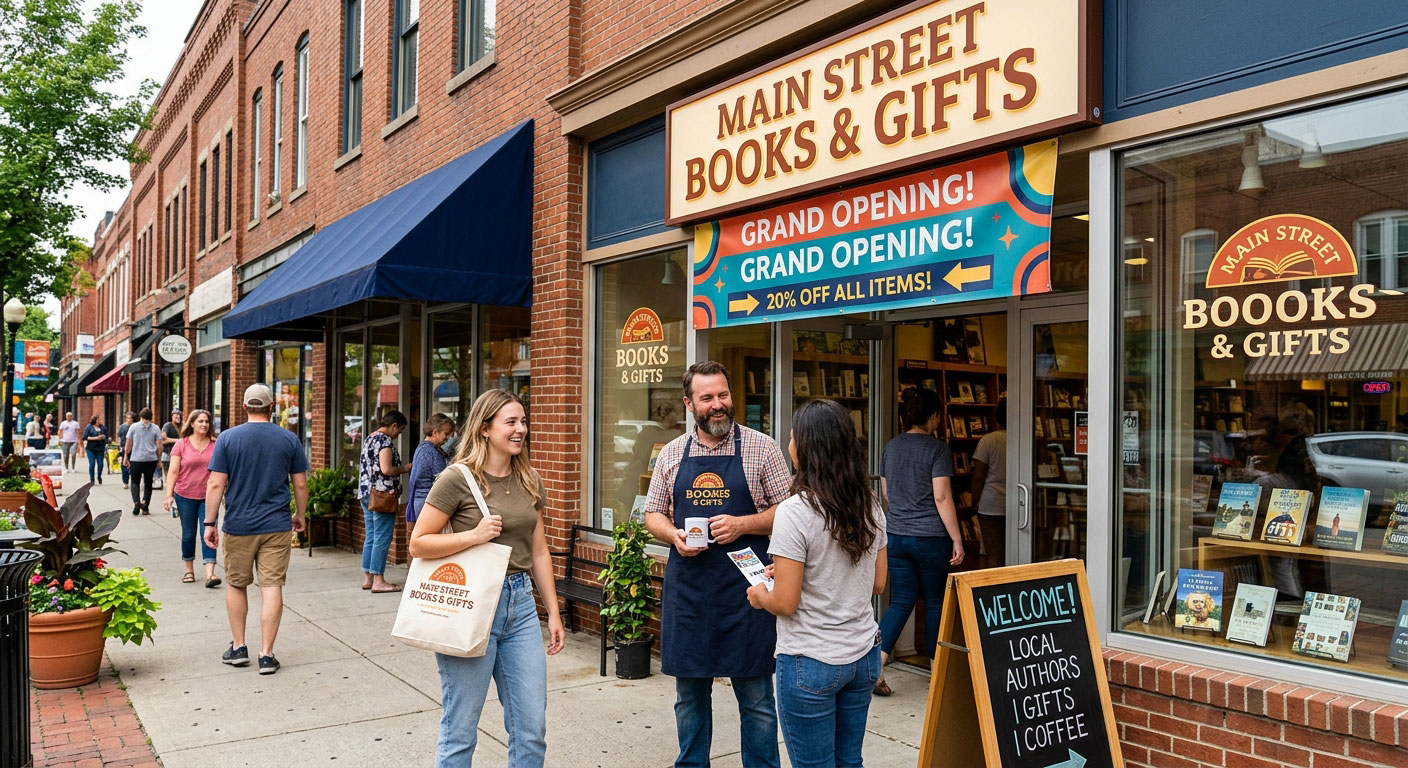
Small business branding doesn’t take a big budget. It takes the right tools, used the right way. Storefront signs, banners, and promotional products are physical branding tools most small business owners can produce without a large marketing budget. Use them together, and each one reinforces the others: more people notice the business, recognize it consistently across formats, and build the kind of familiarity that makes them more comfortable buying from it.
Below is a practical look at how to get more out of each one, and how to get them working together instead of as three separate projects.
Start With a Strong Storefront Sign
Your storefront sign is usually the first thing a customer sees. Often that’s from across a parking lot, or while driving past at 30 miles an hour. That means it has to communicate everything essential in the few seconds someone has to notice it. Use bold letters, strong contrasts, and your logo front and center. Say your business name and what you sell, without making anyone slow down to read it.
There’s a trust factor here too, and it kicks in before a customer walks through the door. A clean, well-lit sign quietly signals that you’re active and that you take the business seriously. Let that same sign fade or the lighting go dim, and it can send the opposite impression to some passersby, whether that’s the intent or not.
Tip: Walk or drive past your own sign at night and again during the day; lighting changes what’s visible more than most owners expect.
Add Banners for Short-Term Promotions
Banners are made for sales, new product launches, and seasonal events, mostly because they’re easy to swap out. Your storefront sign is fixed; it’s your identity. Your banner is the thing that changes month to month. Because it changes, it’s often the piece a regular customer notices again, even after walking past the same storefront many times.
Location matters as much as design. Put banners where they’ll actually be seen near the entrance or facing the direction of foot or car traffic and check with your city or landlord first, since many areas regulate banner size, placement, or how long a temporary sign can stay up. Resist the urge to cram everything onto one banner. “50% Off This Weekend” beats a banner trying to announce five offers at once.
If banners are a regular part of your marketing rather than a once-a-year thing, material matters. Vinyl is a common choice for outdoor use because it’s built to hold up under repeated exposure to weather better than paper or fabric alternatives, which is worth factoring in before choosing a printer, such as BannerFreaks’ custom vinyl banners.
Use Promotional Products to Extend Your Reach
Pens, tote bags, water bottles the point of promotional products isn’t the item itself. It’s where that item goes after someone leaves your store. It ends up on a coworker’s desk, in a car cupholder, or slung over a shoulder at the grocery store. That’s brand exposure happening well beyond the point of sale, in places a business could never buy an ad, even though the item itself isn’t free to produce and hand out.
The catch is quality. A tote bag someone actually likes gets carried around for months. A flimsy one gets tossed in a drawer within a week. Either way, that says something about your business, whether you meant it to or not.
Hand these out at events, tuck them into purchases, or use them as a small thank-you for repeat customers. Do it right, and a one-time buyer becomes someone who keeps carrying a piece of your branding into places you’d otherwise have to pay to reach.
Make Your Branding Work as a System
None of this works as well in isolation. Coordinated branding across your sign, banners, and promo items reinforces recognition every time a customer sees any one of them, since familiarity builds through repetition rather than any single piece doing all the work on its own. The real payoff shows up when your sign, banners, and promo items all look like they came from the same business same colors, same logo, roughly the same tone. That’s the difference between retail branding that’s just decoration and branding people recognize on sight.
A few concrete steps to get there this month:
- Walk through your current sign, banners, and promo items. Write down every place the colors or logo don’t quite match.
- Pick one upcoming promotion and build a banner and a small giveaway item specifically around it, rather than reusing generic leftovers.
- Start asking new customers how they found you, and consider simple trackable methods alongside it a unique offer code on your banner, a QR code linking to a dedicated landing page, or a discount tied to a specific promo item. None of these give perfect attribution, but together with direct customer feedback, they’re a reasonable way to see whether your sign or that tote bag is actually doing anything.
None of this has to happen all at once, and it doesn’t require an unlimited budget. It just takes a little consistency and a handful of tools used with some intention, whether you handle it yourself or bring in outside help as the business grows. Look at what you’ve already got, fix what doesn’t match, and build outward from there.
